How A GFX803 OpenMP Printf Bug Became An AMDGPU M0 Backend Fix
target teams distribute parallel for num_teams(2) num_threads(6) loop on gfx803 printed extra stale lines or crashed. The first working patches targeted LLVM GPU libc and RPC lane masks, but those were too broad and explained too much. The decisive control was gfx906 forced to COV4: the same source worked there. That moved the search from ROCr, COV4, and printf toward GFX8-specific AMDGPU codegen. The final reduced test was pure llc: a noinline callee that forced dynamic v_writelane_b32 through m0, followed by a caller-side flat/private reload. On GFX6-GFX8, m0 is architectural LDS/flat state and must be preserved across calls. Both the SelectionDAG path in SIFixSGPRCopies and the GlobalISel path in AMDGPUInstructionSelector::selectWritelane can borrow it, so the final fix saves and restores m0 in both paths when ldsRequiresM0Init() is true.This was one of those bugs where the first successful fix was not the right fix.
The visible failure was small:
| |
On the working stack, that prints 18 lines and exits normally.
On the broken gfx803 stack, the same shape could print many more lines than
the loop had iterations. A representative failure was 48 output lines instead
of 18, dominated by stale duplicates such as:
| |
Related variants could crash while reading bogus varargs.
That made the bug look like a printf problem. It was not. printf was only
the first convenient operation that made the corrupted state visible.
This post documents the path from the first symptom to the final fix:
- the constraints of the
gfx803OpenMP stack, - why ROCr and code object version 4 were plausible suspects,
- why the first GPU-libc/RPC patches seemed convincing,
- how
gfx906became the control experiment, - how the root cause moved into LLVM’s AMDGPU backend,
- and why the final patch preserves
m0around dynamicv_writelane_b32lowering in both SelectionDAG and GlobalISel.
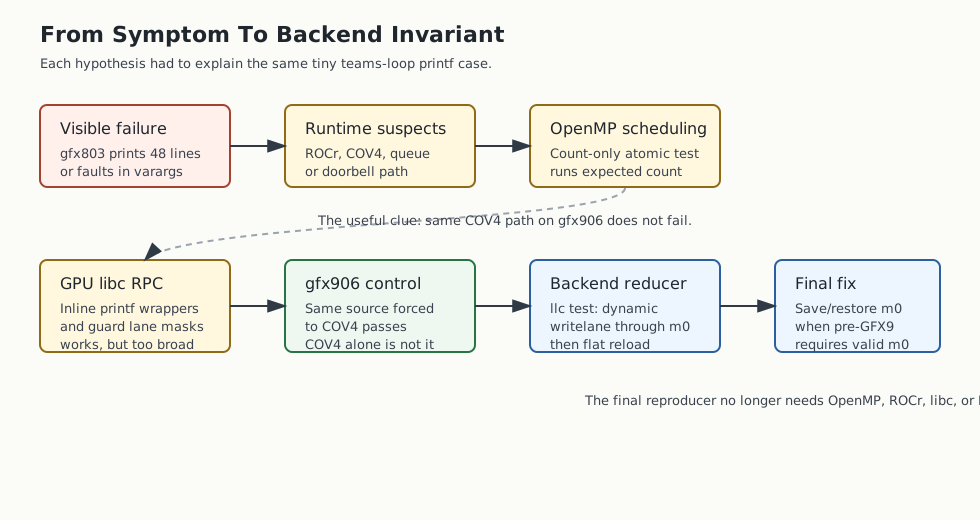
Figure 1. The investigation moved down the stack only when each layer failed to explain the evidence. The useful turning point was not a more clever printf patch; it was a control case that made the bug gfx803-specific rather than COV4-specific.
The Debugging Recipe
Before the retrospective, here is the workflow I wish I had written down at the beginning. It is intentionally mechanical. Each step answers one question and decides whether to stay at the current layer or move lower.
The commands assume the local stack from this work:
| |
env.sh adds the generated compiler wrappers to PATH and exports
LLVM_INSTALL, ROCM_PATH, DEVLIB, LD_LIBRARY_PATH, and the ROCr queue-size
workaround used by this stack. The clang-amdgpu-openmp wrapper is a shortcut
for $LLVM_INSTALL/bin/clang plus -fopenmp,
-fopenmp-targets=amdgcn-amd-amdhsa, the configured --offload-arch list, and
COV4 forwarding for any architecture listed in OMP_AMDGPU_COV4_ARCHES.
For one-architecture control commands below, I spell out $LLVM_INSTALL/bin/clang
and use -Xarch_device -mcode-object-version=4. That form sends the COV4 option
to the only device compilation in the command and is easier to reproduce outside
this local wrapper.
The source file is the small teams-loop case shown above. The expected output is 18 lines: two teams, six threads per team, and eighteen loop iterations.
Step 1: Reproduce The Symptom And Count It
Start by turning “it looks wrong” into a number:
| |
Why this matters:
OMP_TARGET_OFFLOAD=MANDATORYprevents a silent fallback to the host.tee out.txtkeeps the raw evidence.wc -lmakes the failure precise.
The healthy result is:
| |
The broken gfx803 result was not “a little noisy.” A representative failure
printed 48 lines for an 18-iteration loop. That number is the first clue: the
loop is not merely formatting output incorrectly; extra stale lane state is
becoming visible.
Step 2: Prove The Loop Scheduler Is Not Simply Running 48 Iterations
Save this as count_only.c:
| |
Then compile and run it the same way:
| |
Why this matters:
- If the counter is 18, OpenMP is not scheduling 48 clean loop iterations.
- If only
printfshows extra activity, output is exposing corrupted state. - That moves the search toward device runtime calls, active-lane masks, varargs, or caller state around an out-of-line call.
This step prevents a common beginner mistake: staring at the loop scheduler when the loop scheduler is only the messenger.
Step 3: Check Whether This Is Any Device Printf Or This Specific Shape
Save this as direct_printf.c:
| |
Compile and run:
| |
Why this matters:
- If direct
printfworks, GPU libc and the host RPC server are not completely broken. - The failing shape is now narrower: an out-of-line device print from a teams-loop context with divergent lane participation.
At this point, GPU libc/RPC lane masks are a reasonable hypothesis. They are not yet proven.
Step 4: Save Compiler Temps And Look For The First Suspicious Pattern
Ask Clang to keep the intermediate files:
| |
Why this matters:
vprintfconfirms the device-side call path.v_writelane_b32ands_mov_b32 m0point at AMDGPU backend lowering, not just C library logic.flat_loadafter a call is interesting because the caller may reload private loop state after the callee returns.
The first search is intentionally broad. You are not trying to prove the root cause yet. You are finding the next layer to inspect.
Step 5: Separate COV4 From GFX803
At this point, gfx803 and code object version 4 are entangled. The old card
needs COV4 in this stack, and the bug appears on the old card, so COV4 is a
natural suspect.
If a gfx906 device is available, force the same source through COV4 on that
device:
| |
On a machine with multiple GPUs, use the device order reported by
llvm-offload-device-info and set OMP_DEFAULT_DEVICE=<id> if you need to pin
the run to one device. The important thing is not the numeric ID; it is that the
same source and same COV4 setting behave differently across gfx803 and
gfx906.
Then compare it with the gfx803 COV4 result:
| |
Why this matters:
- If
gfx906 + COV4prints 18 lines, COV4 alone is not the root cause. - If
gfx803 + COV4still fails, the failure follows an architecture generation boundary. - That justifies looking for a pre-GFX9 AMDGPU codegen behavior.
This was the decisive control experiment. Without it, the early GPU libc/RPC patches looked much more convincing than they deserved.
Step 6: Inspect The Device Assembly Around The Call Boundary
Now search the generated assembly more narrowly:
| |
Read around the matching assembly lines:
| |
In the broken shape, the important sequence is:
| |
with no matching restore before return.
Why this matters:
s_setpc_b64is the callee return.- If
m0is changed before return and not restored, the caller sees the wrong architectural value. - A caller-side
flat_load_dwordafter the call can then reload loop/private state with badm0state on GFX6-GFX8.
This is the point where the hypothesis changes from “printf has a bad mask” to
“a callee clobbers a register the caller expects to survive.”
Step 7: Check The ABI And The Target Predicate
Do not assume m0 is call-preserved just because the theory needs it. Check the
LLVM source and documentation:
| |
Why this matters:
- The ABI documentation says
M0is preserved on GFX6-GFX8. ldsRequiresM0Init()is LLVM’s existing subtarget boundary for the same generation split.- Using that predicate keeps the fix architectural rather than
gfx803-name specific.
Then find the two lowering paths that can borrow m0 for dynamic writelane:
| |
The important files are:
llvm/lib/Target/AMDGPU/SIFixSGPRCopies.cppllvm/lib/Target/AMDGPU/AMDGPUInstructionSelector.cpp
The first one covers the SelectionDAG path. The second one covers GlobalISel. The complete fix has to handle both.
Step 8: Reduce Below OpenMP
The source-level reproducer proves user impact, but it is too large for an LLVM backend regression test. It depends on OpenMP, ROCr, GPU libc, RPC, and hardware.
The backend reducer should keep only the invariant:
- a noinline callee forces dynamic
llvm.amdgcn.writelane.i32; - that callee would borrow
m0; - the caller performs a private/flat reload after the call.
Run the reduced test with normal SelectionDAG lowering:
| |
Then run the same test through strict GlobalISel:
| |
Why strict GlobalISel matters:
-global-isel-abort=0can silently fall back to SelectionDAG.-global-isel-abort=1proves the GlobalISel selector really handles the function.- Without this, the test could accidentally verify only the path already fixed.
Finally, check the GFX9 control:
| |
Why this matters:
gfx803should save and restorem0.gfx906should not grow unnecessary GFX8 preservation code.- Both SelectionDAG and GlobalISel should be tested explicitly.
That is the debugging ladder in compact form. The rest of the post explains why each rung mattered and why several tempting fixes were eventually removed.
The Stack Was Already Unusual
The machine was not a normal ROCm workstation.
The target GPU was an AMD Radeon Pro WX 3200, a Polaris12 card that reports as
gfx803. The host was loongarch64. The compiler baseline was upstream LLVM
22. The ROCr baseline eventually settled on a forked rocm-6.4.4 runtime
because that release still contains the legacy GFX8 doorbell path needed by this
card.
The working OpenMP stack had several local constraints:
- build LLVM’s AMDGPU OpenMP plugin on LoongArch64;
- build LLVM with both
openmpand the top-leveloffloadruntime enabled; - use ROCr 6.4.4 with small non-x86 portability patches;
- build LLVM-compatible AMD device libraries instead of using the system ROCm bitcode;
- use code object version 4 for
gfx803; - accept AMDGPU HSA ELF ABI version 4 in
libomptarget; - use the COV4 implicit argument size, 56 bytes, when launching COV4 kernels;
- set
LIBOMPTARGET_AMDGPU_HSA_QUEUE_SIZE=64, because larger HSA queues fail on this setup.
The openmp versus offload split is easy to misstate. In LLVM 22, the host
offloading runtime, plugins, tests, and LIBOMPTARGET_GPU_LIBC_SUPPORT build
policy live under the top-level offload/ tree, and this stack must build that
runtime. The historical openmp/device/... paths discussed below are the
device-side OpenMP bitcode runtime sources that still exist in the pinned
llvmorg-22.1.8 tree. This tag does not have an offload/DeviceRTL/
directory.
That context matters because it gave the bug many plausible hiding places.
If a device program crashes while using:
| |
on a private ROCr runtime, an old GPU, and a non-mainstream host architecture, the first instinct is not “LLVM backend register preservation.” It is more likely:
- the runtime is submitting a bad packet,
- COV4 launch metadata is wrong,
- the old GFX8 doorbell path is incomplete,
- the GPU libc RPC server is mishandling a lane mask,
- or OpenMP’s teams loop runtime is scheduling the wrong lanes.
All of those were reasonable hypotheses. Most of them were wrong.
First, Prove That The Runtime Can Launch Anything
Before debugging printf, the lower layers had to work at all.
The ROCr path had already gone through a basic bring-up sequence:
llvm-offload-device-infohad to see the device asgfx803.A raw HSA queue of size 64 had to be created.
A raw HSA barrier packet had to complete.
A scalar OpenMP target region had to run on the GPU.
A reduction test had to print the expected result:
1sum = 15050
Those checks mattered because they separated “the runtime cannot dispatch work” from “one generated device program corrupts itself.”
The raw barrier packet was especially important. It proved that ROCr could:
- enumerate the GPU,
- create a usable queue,
- ring the legacy GFX8 doorbell,
- and make the GPU consume at least one AQL packet.
So when printf failed later, ROCr was not the first place to patch. ROCr only
sees submitted packets, memory accesses, and queue state. If the device code
builds a bad varargs packet or corrupts loop state before talking to the host
RPC server, ROCr cannot repair that.
The Failing Shape Was Suspiciously Specific
The failing source was small, but the shape mattered:
| |
This was not just “device printf never works.”
A direct target-region printf worked:
| |
Small teams-loop variants also behaved differently depending on team/thread
shape. That made it tempting to blame divergent control flow and active-lane
masks. A printf inside a teams loop is a natural stress test for lane-sensitive
device runtime code:
- only a subset of lanes may reach a particular call site,
- the runtime has to describe the active lanes correctly,
- and a variadic call carries enough pointer/state complexity to fault if the wrong lane participates.
The first useful reduction was not a fix. It was a count-only version.
If the loop body updated an atomic counter instead of printing, the loop
executed the expected number of iterations. That was strong evidence that
OpenMP loop scheduling was not simply launching 48 iterations. The extra lines
were not the loop runtime doing extra work in a clean way. They were stale or
inactive lanes becoming visible through printf.
That finding pointed toward GPU libc and RPC.
The First Working Theory: GPU Libc RPC Lane Masks
LLVM GPU libc implements device-side printf for AMDGPU through an RPC path.
The device code opens a port, describes participating lanes, and the host-side
RPC server performs the output operation.
The early theory was:
The output wrapper is out of line, so the active-lane mask is captured in the wrong function context. In a divergent OpenMP teams loop, that could produce a full-wave or stale mask instead of the subset of lanes that actually called
printf.
That theory fit the symptom well enough to produce a patch series:
Split OpenMP GPU-libc stdio support from OpenMP device-runtime allocation.
LLVM’s OpenMP device runtime used
OMPTARGET_HAS_LIBCfor more than one policy. Locally, we wantedprintfandputsto resolve to LLVM GPU libc, but we did not want OpenMP internal allocation to route through LLVM libc’s GPUmalloc/freepath.Mark GPU libc output entry points as call-site-inline.
The local patch introduced a
LIBC_GPU_RPC_INLINEmacro and applied it to GPU stdio wrappers such asprintf,vprintf,fprintf,puts,fwrite, and related output functions. The idea was to force RPC mask calculation to happen at the real divergent OpenMP call site.Guard GPU-side RPC callback invocation by the lane mask.
The callback code was changed so a GPU lane only handled its slot if the RPC packet mask included that lane.
This was not irrational. It matched the visible bug, it made the local tests pass, and it produced a plausible story:
- count-only loop works,
- output path fails,
- output path has lane masks,
- inline the output path and guard the mask.
The problem was that it was too convenient. It fixed printf, but it did not
prove that printf was the root cause.
Why The First Fix Was Not Good Enough
The warning sign was scope.
The patch touched broad GPU libc and device-runtime behavior across the LLVM 22 offload build surface and the device-side OpenMP runtime sources:
offload/CMakeLists.txtand theLIBOMPTARGET_GPU_LIBC_SUPPORTbuild policy,openmp/device/CMakeLists.txtandopenmp/device/src/LibC.cppin thellvmorg-22.1.8DeviceRTL source tree,libc/src/__support/macros/attributes.h,- many
libc/src/stdio/gpu/*.cppfiles, - and
libc/shared/rpc.h.
That is a lot of surface area for a bug that only appeared on gfx803 in one
small teams-loop shape.
The more important concern was conceptual:
If
printfonly exposes corrupted device state, then everyprintf-specific fix is a mask.
Imagine adding a new GPU runtime operation tomorrow:
| |
If all of them would fail because the caller’s state was already corrupt, then
patching printf would be the wrong engineering move. The right fix would be
where the state became corrupt.
That is why the first working patch series was eventually removed. It was useful as a debugging step, but it had the wrong shape for a root-cause fix.
The Control Experiment: Force COV4 On GFX906
The decisive experiment came from reinstalling the MI50, a Vega 20 GPU that
reports as gfx906.
At first, the old card and code object version 4 were entangled:
gfx803needed COV4 for the local stack,- the failing case ran on
gfx803, - and COV4 support had been re-enabled locally in LLVM 22.
So COV4 itself remained a suspect.
The control was simple:
- Run the same source on
gfx803with COV4 and without the localprintfworkaround. - Confirm that the old failure still reproduces.
- Run the same source on
gfx906, also forced to COV4. - Check whether the same corruption appears.
The result changed the investigation:
| |
That ruled out “COV4 alone” as the explanation.
It also made the broad RPC hypothesis less satisfying. The same LLVM GPU libc
RPC path could run through COV4 on gfx906 without producing the same stale
lines. Something about the pre-GFX9 backend path mattered.
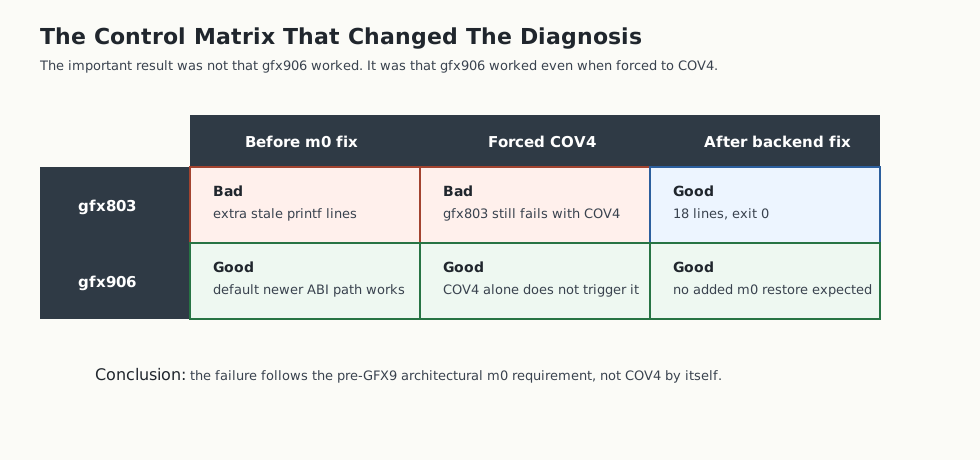
Figure 2. The matrix separated code object version from architecture generation. COV4 was necessary for the old card, but it was not sufficient to cause the bug.
Looking Below Printf
The next step was to inspect what printf made the compiler generate.
The important pattern was not “RPC” by itself. It was an out-of-line callee, generated for GPU libc/RPC support, followed by caller-side reloads of private loop state.
On AMDGPU, private memory can be accessed through flat addressing. On older
generations, some local/LDS/flat behavior still depends on a special scalar
register named m0.
That was the missing background.
I did not initially know what m0 was, and that was part of the debugging
problem. It is not just another temporary SGPR. In the AMDGPU ABI for GFX6-GFX8:
- kernel prolog code initializes
m0to a value suitable for LDS access; m0is used for LDS range checking on GFX6-GFX8;- GFX9 and later no longer need
m0for LDS range checking; - on function exit, GFX6-GFX8
m0is documented as preserved.
The plain-language version is:
On GFX6-GFX8, if a callee borrows
m0, it has to return it in the condition it found it. Otherwise the caller may use a bad architectural register value for later memory operations.
That is exactly the kind of bug that can make a later printf look guilty even
though the actual corruption happened earlier.
The Actual Bad Sequence
The broken sequence looked like this:
- The caller enters with a valid
m0value. - The caller calls an out-of-line GPU libc/RPC helper.
- Inside the callee, LLVM lowers a dynamic
v_writelane_b32. SIFixSGPRCopiesborrows physicalm0as the lane selector.- The callee returns without restoring the original
m0. - Back in the caller, later flat/private reloads run with the wrong
m0. - Loop state becomes stale or corrupt.
printfobserves extra lanes or bad varargs.
In the concrete failure, small values such as lane ids were especially bad. A callee might return with:
| |
instead of the caller’s valid LDS/flat value. Subsequent private/flat reloads could then read the wrong state.
This explained the strange symptom:
- the loop did not schedule extra clean iterations;
- instead, stale lane state made extra output appear;
- variadic data could be read through corrupted state;
- and
gfx906avoided the same failure because GFX9 no longer has the samem0requirement for LDS range checking.
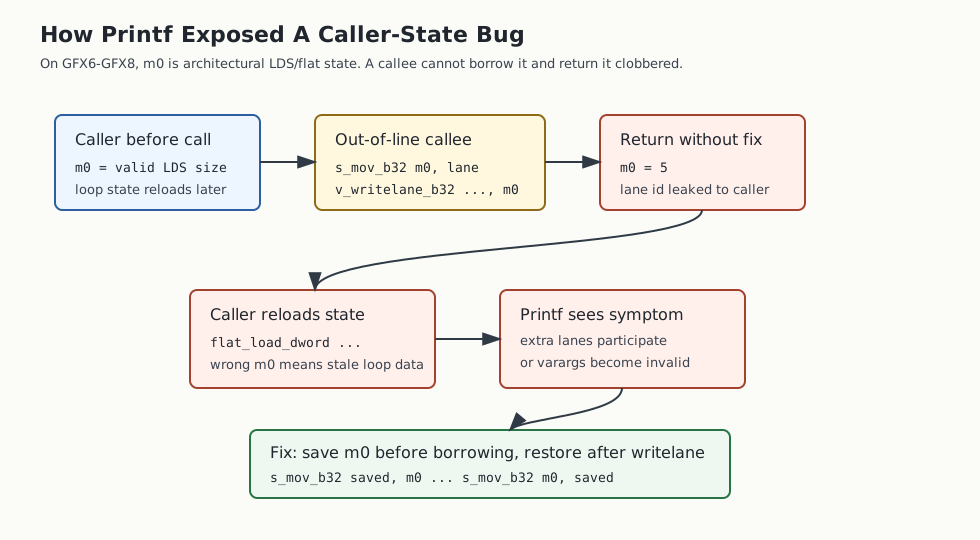
Figure 3. printf was the visible symptom. The actual bug was a callee that borrowed architectural m0 on GFX8 and returned it clobbered.
Why Dynamic Writelane Used M0
The first relevant LLVM code lives in SIFixSGPRCopies.
v_writelane_b32 is special. On subtargets with a one-SGPR constant-bus limit,
the instruction still has to obey the “one SGPR” rule. The lane selector can use
m0 without counting as a normal constant-bus use, so the pass may rewrite the
instruction by moving one source operand into m0.
The simplified lowering shape is:
| |
That is fine if m0 is just scratch state.
On GFX6-GFX8, it is not scratch state.
LLVM already has a subtarget predicate for this boundary:
| |
That predicate means: this target is before GFX9, so LDS/flat behavior still
requires a valid m0 value.
The bug was not that LLVM used m0 at all. The bug was that this lowering path
borrowed m0 without preserving the incoming value on targets where m0 is
part of the call-preserved architectural state.
The follow-up audit found the same idea in GlobalISel:
AMDGPUInstructionSelector::selectWritelane can also copy a dynamic lane
selector through physical M0. That made the first backend patch incomplete.
The user-facing OpenMP bug happened to expose the SelectionDAG path, but an ABI
fix has to cover every backend path that can return from a callee with m0
clobbered.
The Pure Backend Reproducer
The clean test had to remove OpenMP, ROCr, GPU libc, and the RPC server.
The reduced LLVM IR does three things:
- Create a noinline callee that forces dynamic
llvm.amdgcn.writelane.i32. - Call it from a kernel.
- Perform a caller-side private/flat reload after the call.
The important part is the callee:
| |
And the caller-side reload:
| |
The test checks two targets and two lowering paths.
The RUN lines are deliberately explicit:
| |
The first and third lines cover the normal SelectionDAG path. The second and
fourth lines force GlobalISel and make fallback a hard error. That detail
matters: -global-isel-abort=0 would allow a silent fallback to SelectionDAG,
which could hide a missing AMDGPUInstructionSelector fix.
For gfx803, the generated assembly must save and restore m0:
| |
For gfx906, the test verifies that the GFX8-specific save/restore is not
inserted:
| |
That is what made the fix upstream-grade enough for a local patch series: it was
no longer an OpenMP reproducer, a ROCr reproducer, or a printf reproducer. It
was a backend reproducer, and it checked both AMDGPU instruction selection
routes that can borrow m0.
The Final Patch
The final patch is still small, but it has two code paths.
In the SelectionDAG path, SIFixSGPRCopies saves m0 into a normal SGPR before
borrowing it if the subtarget still needs valid m0 for LDS/flat operations:
| |
Then perform the existing borrow:
| |
And restore immediately after the v_writelane_b32:
| |
These snippets use LLVM 22’s BuildMI(MachineBasicBlock &, MachineInstr &, ...)
overload. Passing MI here is not pseudocode; the local LLVM build used this
exact form. The equivalent iterator form would also be possible, but the patch
keeps the style already used in nearby AMDGPU backend code.
The same preservation is needed in the GlobalISel selector. The equivalent
lowering lives in AMDGPUInstructionSelector::selectWritelane, where the lane
selector can also be constrained to SReg_32_XM0RegClass and copied through
physical M0:
| |
The GlobalISel part is easy to miss because OpenMP normally reached the
SelectionDAG path in this setup. But the ABI rule is not conditional on which
instruction selector produced the callee. If GlobalISel can emit the same
dynamic writelane-through-m0 sequence on GFX6-GFX8, it has to preserve m0
too.
This is narrower than the earlier GPU-libc/RPC workaround in three ways.
First, it is not specific to printf. If another device runtime operation
exposes the same caller-state corruption later, the same backend fix applies.
Second, it is not broad GPU libc policy. It does not change stdio wrappers, allocation selection, or generic RPC callback behavior.
Third, it is gated by an existing architectural predicate:
| |
That currently means getGeneration() < GFX9, so the extra save/restore applies
to GFX6-GFX8 and avoids changing the generated code for GFX9+.
Verification
The final validation happened at several layers.
Patch application against pinned sources:
| |
Backend regression through the stack’s verification helper:
| |
Direct backend regression commands:
| |
Optimization sweep for the GFX8 target:
| |
Device discovery:
| |
Mixed-device OpenMP smoke test:
| |
The original gfx803 teams-loop reproducer:
| |
The reduction test:
| |
The most important verification was not the final “it works” run. It was the negative/positive split:
gfx803without the fix still showed the old corruption;gfx906forced to COV4 did not;gfx803with the backendm0fix printed exactly 18 lines.
That split is what kept the final patch narrow.
What The Old Patches Taught Us
The removed patches were not wasted work.
They proved several useful things:
- GPU libc was actually linked and the RPC server could run.
printfandputscould work on this stack.- The failure was after kernel launch, not at device discovery or queue creation.
- Lane-sensitive runtime code was a plausible exposure point.
But they also illustrated a common debugging trap:
A patch that makes the symptom disappear can still be at the wrong layer.
The first patch series made sense when the only failing observation was “device
stdio in a divergent teams loop fails.” It became less defensible after the
gfx906 COV4 control worked and after the reduced backend test reproduced the
exact missing preservation pattern.
That is the main lesson from this bug. The fix should be where the invariant is violated, not where the symptom is printed.
Practical Takeaways
There are a few lessons I would carry into the next offloading bug.
First, keep a control GPU if possible. The MI50 was not just a faster or newer device. It was the experiment that separated “COV4 is broken” from “the pre-GFX9 backend path is broken.”
Second, never trust printf as the root cause just because printf is the
first visible failure. Variadic output is excellent at exposing corrupted state.
That does not mean output created the corruption.
Third, reduce below the runtime when the evidence points below the runtime. A
pure llc reproducer is dramatically stronger than an OpenMP reproducer when
the suspected bug is in instruction selection or a late machine pass.
Fourth, if the backend has more than one lowering path, test the one you think
you fixed and the one you might have forgotten. SelectionDAG covered the path
that exposed this OpenMP bug, but GlobalISel had equivalent m0 borrowing logic.
Using -global-isel-abort=1 made that test strict instead of allowing a quiet
fallback.
Fifth, old architecture support often fails at forgotten architectural seams.
For GFX6-GFX8, m0 is one of those seams. It is easy to think of it as a
temporary scalar register until a callee returns with the wrong value and the
caller starts reloading stale private state.
Finally, keep local patches indexed and disposable. The early GPU-libc/RPC patches were easy to delete because they were isolated patch files. Once the root cause moved, the patch series could move with it.
Conclusion
The final state is much simpler than the path that found it.
The OpenMP stack still needs local work for this old card:
- ROCr 6.4.4 for the legacy GFX8 doorbell path,
- LoongArch64 host portability patches,
- COV4 ELF acceptance,
- COV4 implicit argument sizing,
- explicit
gfx803COV4 compile flags, - queue size 64.
But the teams-loop printf corruption is no longer handled by a special GPU
libc workaround. It is handled where it belongs: in the AMDGPU backend lowering
paths that borrow m0.
The fixed rule is straightforward:
If any dynamic
v_writelane_b32lowering path borrowsm0on a target where LDS/flat operations requirem0to remain valid, save it first and restore it after the instruction.
That is the kind of conclusion I want from a debugging session: fewer patches, smaller scope, a pure regression test, and a reason the fix applies to the architecture rather than to one lucky symptom.