A Human Review Guide For The REX Clang Frontend Stabilization PR
Large compiler PRs are hard to review.
The merged REX Clang frontend stabilization PR changed 275 files. It included root-cause frontend fixes, midend consumer updates, test harness work, reference-output updates, submodule movement, hook fixes, and review follow-ups. Reading that diff from top to bottom is possible, but it is not the best way to understand risk.
The practical review question is different:
| |
This post is a review guide for that kind of PR. It is written for the reviewer who wants to audit a large compiler stabilization change after the fact, or review the next one without losing the plot.
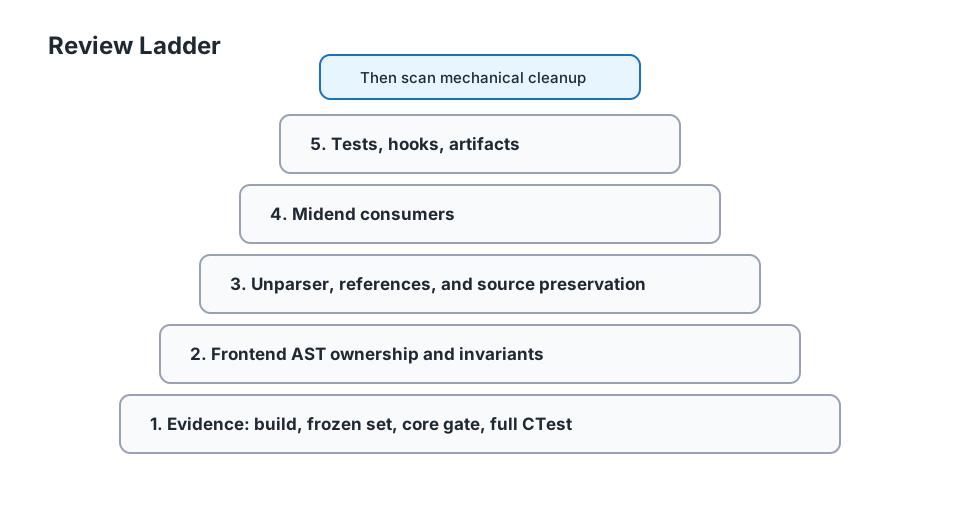
Figure 1. A large compiler PR should be reviewed by risk layer, not by raw file order.
Start With The Evidence
Before reading implementation details, inspect the evidence.
For this PR, the key evidence was:
| |
This does not prove every line is correct. It tells the reviewer which claim the PR is making.
The claim is not “this code looks plausible.” The claim is:
| |
Review should then ask whether the implementation justifies that evidence. If a patch makes tests pass by skipping tests, weakening assertions, or hiding errors in the unparser, the evidence becomes less valuable. If the patch strengthens compiler invariants and the tests pass, the evidence becomes meaningful.
So the first review pass should verify that the PR did not change the rules of the game:
- no deleted valid tests to make failures disappear,
- no broad CTest pass-property masking,
- no expected-failure conversion for real compiler bugs,
- no assertion softening without a proven design correction,
- no unparser string hacks that fabricate output around malformed AST state.
Only after that should the reviewer dive into compiler internals.
Do Not Review The PR As One Diff
The worst review strategy is to open the file list and proceed alphabetically.
That gives low-risk files and high-risk files the same attention. It also puts reference-output churn next to implementation changes without context. A reviewer can spend an hour confirming expected-output spelling and still miss a frontend ownership change that determines whether those outputs are meaningful.
Instead, build a review index:
| |
Within semantic compiler changes, review producers before consumers. The Clang frontend produces AST state. The unparser, token layer, and midend consume it. If a consumer fix looks suspicious, the reviewer should first decide whether the producer is now emitting valid state. If not, the consumer fix may be compensating for the wrong problem.
This ordering also makes review comments more useful. A comment on an output diff can point back to an AST invariant. A comment on a midend traversal can ask which Clang-built shape it is adapting to. A comment on a hook can ask whether it improves or weakens future evidence.
Review Path 1: Frontend AST Ownership
The highest-risk and highest-value changes are in the Clang frontend.
This path should be reviewed around invariants, not individual helper names. For each frontend change, ask:
| |
The main invariants are:
- every materialized declaration has the right parent and scope,
- declarations that need symbols are inserted into the right symbol table,
- defining and nondefining declarations agree,
- tags and typedefs preserve completion and redeclaration relationships,
- templates preserve parameter, argument, and specialization structure,
- lambdas and hidden friends live in the correct scope,
- source locations distinguish main-file, header, macro, implicit, and generated state.
The reviewer should look for centralization. A large frontend is dangerous when each path creates declarations differently. A good fix reduces the number of places that must remember the same invariants.
Suspicious signs include:
- a special case for one test filename,
- a declaration created without a clear scope owner,
- a symbol inserted after the fact without checking the declaration pair,
- a type built from a simplified spelling instead of the resolved AST relationship,
- a fallback that returns a placeholder node silently.
Acceptable signs include:
- explicit ownership transfer or copy semantics,
- assertions that catch impossible AST states early,
- helpers that make declaration pairing consistent,
- tests that cover both direct frontend output and downstream generated-source compilation.
Review Path 2: Backend And Unparser Changes
The unparser is a dangerous place to review because it can make bad AST state look good.
The reviewer should start with one question:
| |
The first category is good. The second category is usually a bug.
For this PR, the user-facing rule was strict: no unparser hacks. That means no fragile string-based attributes and no output-only special cases that hide frontend bugs. If an enum, typedef, template argument, declaration pair, or scope is wrong, the fix belongs in the AST construction or fixup path, not in a string patch during unparsing.
Reviewers should pay special attention to:
- declaration ordering,
- tag definitions before uses,
- typedef and elaborated-type spelling,
- anonymous tag output,
- namespace and same-scope grouping,
- comment placement,
- preprocessing directive attachment,
- token-based unparsing boundaries.
Reference-output updates should be reviewed next to the input source. The key question is semantic equivalence. One space or stable formatting change may be fine. Moving a comment across a statement boundary is not fine. Collapsing a standalone comment into a trailing comment may be wrong if the original placement carried meaning for a reader or tool.
Review Path 3: Midend Consumers
After frontend and unparser review, inspect midend changes.
This PR had consumer fixes in callgraph, dataflow, CFG, inlining, outlining, move-declaration, normalization, and single-statement block normalization areas. The risk is different from frontend risk.
The reviewer should ask:
| |
Adapting to valid nodes is healthy. For example, a dataflow lattice API that clarifies ownership and prevents leaks is a real fix. A callgraph traversal that handles lambdas or operators deterministically can be a real fix. An inliner fix that preserves reference-shadow parameters can be a real semantic repair.
Compensating for invalid state is suspicious. If a midend pass starts ignoring missing symbols, skipping malformed declarations, or swallowing assertion failures, the reviewer should push the fix back toward the frontend.
Good midend changes usually have narrow behavior:
- preserve symbols when moving declarations,
- keep initializer dependencies intact,
- maintain declaration pairs,
- copy owned state rather than sharing raw pointers,
- handle implicit or Clang-built nodes explicitly,
- keep traversal ordering deterministic.
Bad midend changes usually hide information:
- skip nodes without reporting why,
- accept null scopes as normal,
- weaken equality checks to reduce failures,
- discard token or source-location state during transformation.
Review Path 4: Tests And Reference Outputs
Tests are both evidence and risk.
For a cleanup PR, the reviewer should group test changes into categories:
| |
New focused tests are usually easiest to review. They should live in the right layer. A builtin or unit-style regression should not be added to an upstream benchmark corpus just because that corpus happened to expose the bug.
Reference updates are high risk. The reviewer should compare the input and output and ask:
- is this only stable formatting,
- is the semantic program unchanged,
- are comments still attached to the right construct,
- did a declaration move because the compiler now orders it correctly,
- or did the output simply accept a wrong AST?
Timeout and scheduling updates should be treated as suspicious until proven otherwise. Raising a timeout can be correct for a legitimately long aggregate test, but it should not be the first response to a compiler getting lost. The Cxx_Grammar.C timeout fix was acceptable because the root cause was traversal policy, not because the timeout was hidden.
Test-output path fixes are usually low risk and high value. Generated artifacts belong in the build tree, not as untracked source-tree pollution.
Reviewing Reference Output Without Guessing
Reference-output review should be concrete.
Do not ask only whether the new output compiles. Ask how it relates to the input. For each representative reference update, inspect the original source, the previous expected output, and the new expected output. Then classify the change:
| |
The first three can be acceptable. The last three need more evidence.
Comment placement deserves special handling. A comment immediately before a statement usually belongs to that statement in the reader’s model, even if the compiler treats it as trivia. Moving it after the statement can be a source-preservation bug. Similarly, moving preprocessing directives across declarations can change the apparent structure of a source file even when the compiled program remains the same.
For a large PR, reviewers should sample references by failure family rather than reading every output file in isolation. Pick examples from token tests, source-position tests, Cxx generated-output tests, ELSA-style cases, and OpenMP/Fortran guardrails. If each family has a coherent explanation, the review becomes tractable.
Review Path 5: Tooling, Hooks, And Submodules
Tooling changes deserve their own pass because they affect future trust.
The failure ledger, pre-push hook logging, and test-output hygiene changes were not compiler semantics, but they shaped the workflow. Reviewers should check that tooling makes failures more visible, not less visible.
For hooks, the question is:
| |
For submodules, the reviewer should check that the submodule change has its own upstream explanation and does not smuggle unrelated changes into the parent PR. In this case, the ompparser update had already gone through its own branch and PR before REX consumed the updated submodule pointer.
For temporary files and generated outputs, the question is whether the source tree stays clean after tests. A test that leaves iostream.h-style artifacts or benchmark output in tracked source directories is not just annoying. It makes future diffs less trustworthy.
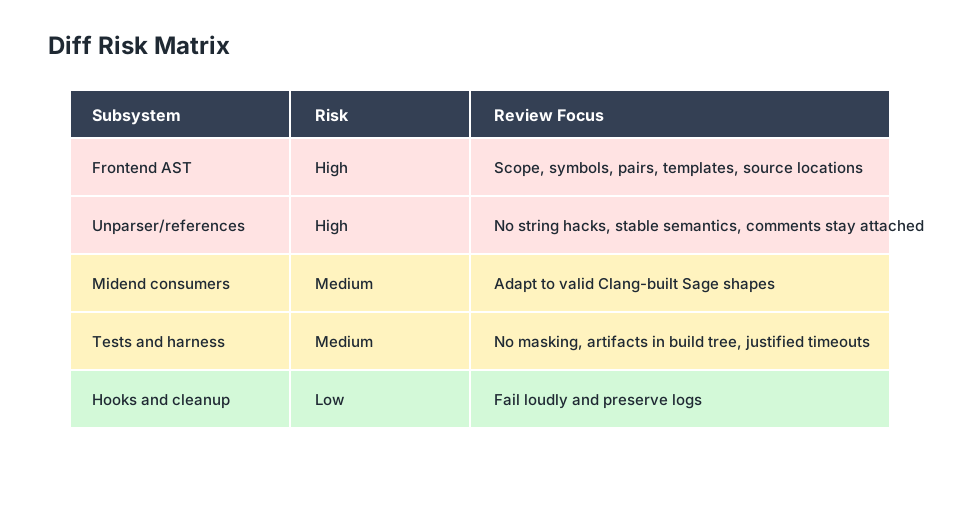
Figure 2. Not every changed file carries the same risk. Review should spend the most time where a passing test can still hide a compiler invariant mistake.
What Should Make A Reviewer Stop
Some patterns should trigger an immediate pause.
The first is string-based special casing in the unparser. If the code recognizes a broken type or declaration by spelling and prints what the test expects, the PR is hiding a compiler bug.
The second is test masking. Any skip, expected-failure marker, or pass-property change must be treated as suspect unless the test is truly invalid or environment-specific.
The third is ownership ambiguity. Raw pointers crossing APIs without a clear owner are especially dangerous in compiler data structures. A later review comment on the live/dead lattice code caught exactly this risk: deep-copy behavior was correct, but the raw pointer signature suggested possible ownership transfer. The final fix made the parameter a non-owned reference and kept internal copying explicit.
The fourth is comment drift. Comments are not executable semantics, but source-to-source compilers must treat them as user source. Moving comments across statements can be a real output bug.
The fifth is a local fix that reduces one failure count while making the frozen set worse. That is a failed patch, not progress.
Reviewing The Commit Sequence
The final PR contained the initial large cleanup plus review-response commits. A reviewer should not treat those follow-up commits as noise.
Review-response commits often reveal the most important risk boundaries. In this campaign, they covered hook logging, temporary directory races, Fortran OpenMP output flags, traversal and access checks, copy races, ownership leaks, inliner reference parameters, and live/dead lattice ownership. Those topics are exactly where large compiler PRs can leave sharp edges.
The practical method is:
| |
If a review-response commit merely suppresses the complaint, it is weak. If it changes the implementation so the complaint cannot recur in the same form, it is strong.
Matching Evidence To Subsystems
No single test proves a subsystem correct.
The best review habit is to match each subsystem to the evidence that would catch its failure:
- frontend declaration fixes: generated-source compile tests, ELSA/Cxx/Cxx11/CXXCODE, focused REX frontend cases,
- token/source-position fixes: tokenStream, tokenStreamMapping, SOURCEPOSITIONTEST, unparse_tokens,
- unparser fixes: compile-after-unparse, reference diffs, header unparse tests,
- midend fixes: callgraph, CFG, dataflow, def-use, inliner, outline, moveDecl,
- OpenMP and Fortran guardrails: core gate and full suite labels,
- workflow fixes: hook logs, clean worktree after tests, ledger comparisons.
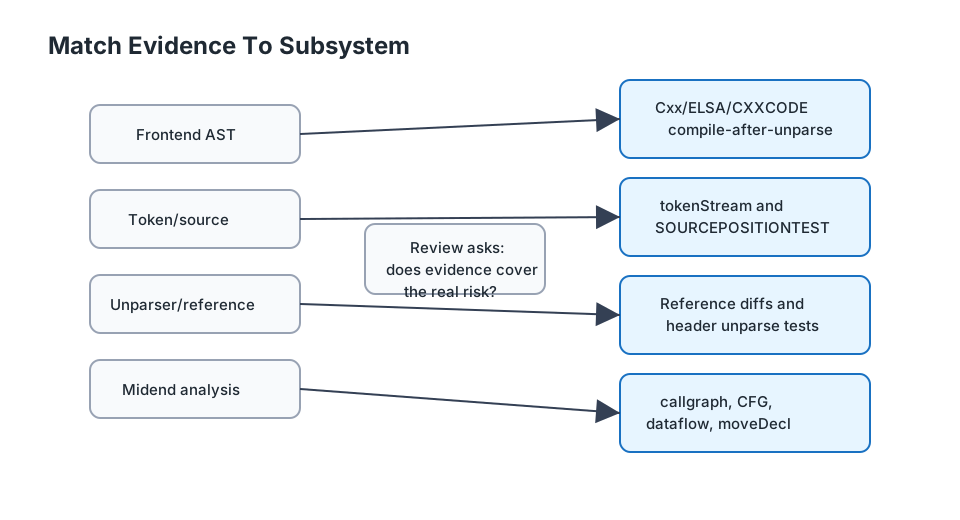
Figure 3. Evidence should be matched to the subsystem it actually exercises. A green local test is useful only if it covers the risk being reviewed.
The Practical Review Order
For a future PR like this, I would review in this order:
- Read the PR summary and validation evidence.
- Search for test masking, assertion weakening, and unparser string hacks.
- Review frontend AST invariant changes.
- Review unparser and reference-output changes with source inputs nearby.
- Review midend consumer fixes as adaptations to valid AST shapes.
- Review test-harness and generated-output hygiene.
- Review hook and workflow changes.
- Only then scan the remaining mechanical diff.
That order is not glamorous, but it is practical.
Large compiler PRs are not reviewed well by trying to understand every line equally. They are reviewed well by knowing where a wrong line can do the most damage.